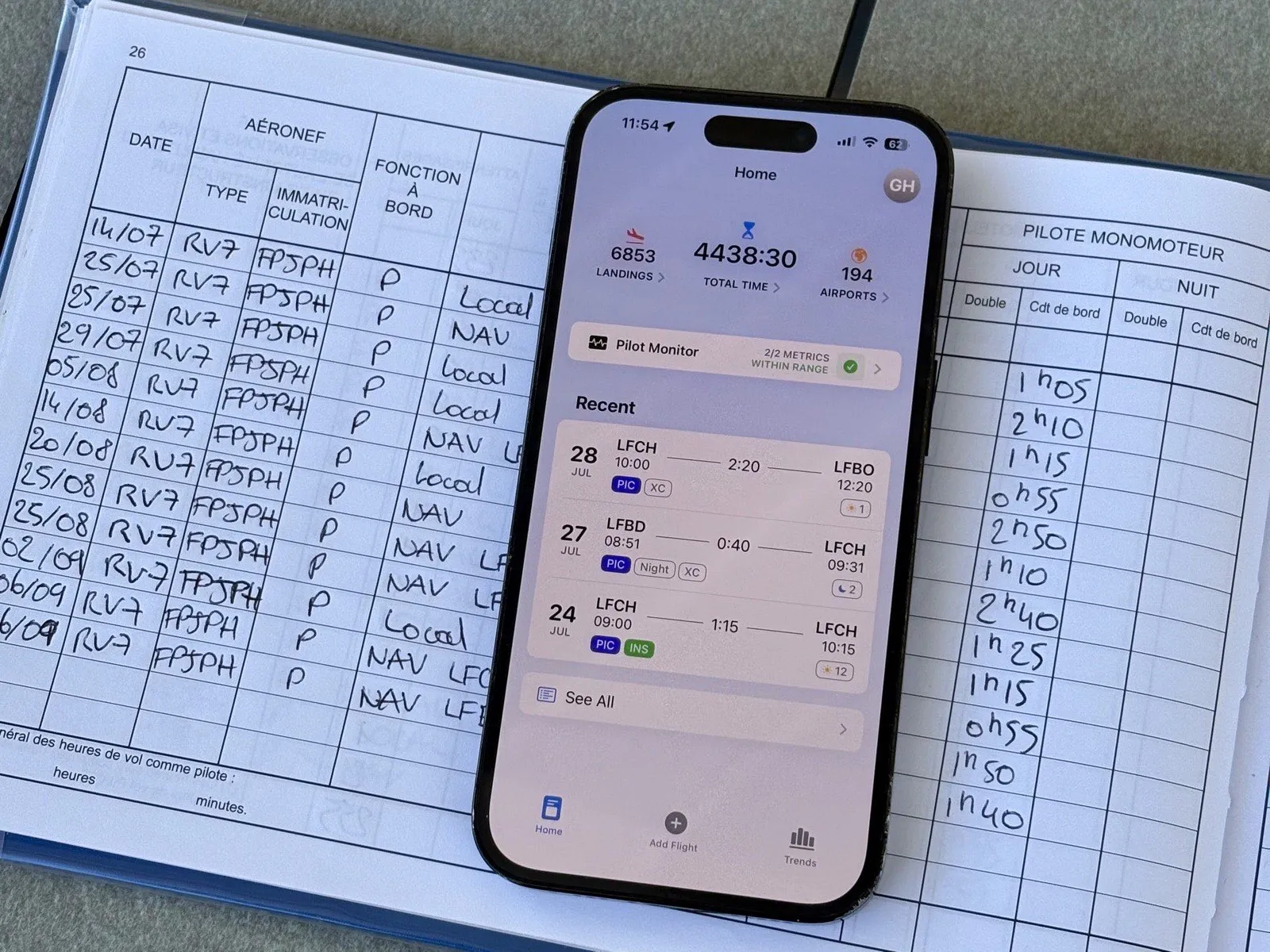
For decades, the pilot logbook has looked the same: a leather-bound book, columns of handwritten entries, totals calculated with a calculator (or in your head after a long flight). It works. Pilots have built entire careers on paper logbooks.
Digital logbooks add automatic backups, live totals, search, and formatted exports. This comparison looks at those gains alongside the tradeoffs of moving away from paper.
TL;DR
- Paper logbooks are simple, universally recognized, and satisfying to keep, but they are vulnerable to loss, damage, and calculation errors.
- Digital logbooks add backups, search, automatic totals, currency tracking, and formatted exports.
- Authorities accept digital records when they contain the required information and remain available for inspection.
- For most active and professional pilots, a digital primary logbook plus independent backups is the safer long-term setup.
The Case for Paper Logbooks
Paper logbooks have survived this long for good reasons.
They’re simple. No apps to learn, no subscriptions, no passwords. You open the book, you write, you close it. Done.
They’re accepted everywhere. Every examiner, every airline, every authority in the world recognizes a paper logbook. There’s never a question of format compatibility or whether your file will open.
They feel tangible. There’s something satisfying about flipping through years of entries, seeing your handwriting evolve, remembering flights by the ink on the page. A paper logbook is a physical artifact of your flying life.
No technology dependencies. No batteries, no updates, no servers going down. Your paper logbook works on a remote airstrip the same way it works at home.
The Problems with Paper
But paper logbooks come with real risks that pilots often underestimate until it’s too late.
They can be lost or destroyed. Left in a car that got broken into. Damaged in a flood. Forgotten in a hotel room. Lost in a move. Once it’s gone, it’s gone. Reconstructing hundreds or thousands of hours from memory and old records is a nightmare, and sometimes impossible.
They’re prone to errors. Manual calculations lead to mistakes. Transposition errors. Columns that don’t add up. Incorrect totals discovered right before a checkride or interview. Unlike a spreadsheet, you can’t just fix a formula. You’re stuck with correction fluid and cramped margins.
They’re hard to search. Need to know how many hours you flew in a specific aircraft type three years ago? Prepare to flip through dozens of pages and tally by hand.
They don’t travel well. Carrying your only copy of your career everywhere you go is risky. And making photocopies of every page is tedious.
Exporting is manual. When an airline asks for your hours in a specific format, you’re transcribing everything by hand into their spreadsheet. Hours of work, and another opportunity for errors.
The Case for Digital Logbooks
Digital logbooks solve most of paper’s weaknesses.
Automatic backups. Your data lives in the cloud. Lose your phone, break your tablet, it doesn’t matter. Your logbook is safe and recoverable.
Accurate calculations. Totals update automatically. Night time, IFR time, PIC, SIC, everything is calculated for you. No more arithmetic errors before a checkride.
Instant search and filtering. Need your multi-engine time from the last 12 months? Two taps. Need to see every flight you did in a specific aircraft? Instant.
Professional exports. Generate polished PDFs in EASA, FAA, or other authority formats in seconds. No transcription, no reformatting.
Offline access. Good digital logbooks work without internet. Log a flight at 35,000ft or on a grass strip with no signal. Sync when you’re back online.
Your data travels with you. Your entire flying history in your pocket, accessible from any device, anywhere.
The Problems with Digital
Digital logbooks have their own drawbacks.
Subscription fatigue. Some apps charge monthly or annually. Over a 30-year career, that adds up. Make sure the value justifies the cost.
Learning curve. Any new tool takes time to learn. Some apps are intuitive, others feel like they were designed by engineers who never sat in a cockpit.
Data portability concerns. What happens if the app shuts down? Can you export your data? Make sure you’re not locked into a platform that could disappear.
Authority acceptance. Most authorities accept digital logbooks, but some examiners still prefer paper. Check your local requirements, and always be able to produce a printed copy if needed.
Over-reliance on technology. If you can’t access your phone or the app has a bug on checkride day, you need a backup plan.
Paper vs Digital at a Glance
| Factor | Paper | Digital |
|---|---|---|
| Backup | Manual photocopies only | Automatic, redundant |
| Totals | Hand-calculated | Auto-calculated, updated in real time |
| Search | Page-by-page | Instant |
| Authority exports | Manual transcription | One-tap PDF in EASA, FAA, and other formats |
| Risk of total loss | High (fire, theft, water damage) | Low if synced |
| Upfront cost | 20 to 50 euros once | Free options or trials to roughly 80 euros per year |
| Learning curve | None | Minutes to hours |
| Time to log one flight | 30 to 90 seconds | 10 to 30 seconds |
| Works at remote airstrip | Always | Yes, with an offline-first app |
| Accepted by every authority | Yes | Yes, subject to format requirements |
What authorities actually say about digital logbooks
Digital logbooks are not a grey area. They are explicitly recognised by every major civil aviation authority, each with specific conditions.
EASA accepts electronic logbooks under Part-FCL FCL.050. The logbook can be kept on paper or in electronic form, provided it captures the required columns and can be produced on request.
FAA accepts electronic logbooks under 14 CFR 61.51 with no formal approval process. The regulation requires that the record be reliable and that you be able to produce it when asked. Nothing in the rule favours paper.
TCCA, UK CAA, JCAB, GCAA, and CASA all accept electronic logbooks under similar terms. The common thread: the record must be accurate, complete, and accessible.
In practice, you are covered if your app produces a compliant export and keeps your data accessible. Some examiners still prefer paper out of habit, not because the regulations require it. If an examiner asks for paper, a digital logbook should be able to produce a printable copy.
When Paper Still Makes Sense
Paper might be the right choice if:
- You fly infrequently (a few times a year) and don’t want another app in your life
- Your local authority or flight school strictly requires paper
- You genuinely enjoy the ritual of handwriting your entries
- You already have decades of entries in paper and don’t want to migrate
When Digital is the Clear Winner
Digital is almost certainly better if:
- You’re building hours toward a professional career
- You fly frequently and need accurate, up-to-date totals
- You want protection against losing your logbook
- You’ll need to produce professional exports for airlines or authorities
- You value being able to search and analyze your flying history
What to Look for in a Digital Logbook
A useful digital logbook should meet these requirements:
Offline functionality. You should be able to log flights without internet. This is non-negotiable for pilots.
Cloud backup. Your data should be automatically synced and protected. If you lose your device, you shouldn’t lose your logbook.
Authority-compliant exports. The app should generate PDFs that meet the format requirements of major authorities like EASA, FAA, and others. A pretty interface means nothing if your export gets rejected.
Data portability. You should be able to export your raw data (CSV, JSON, or similar) so you’re never trapped in one platform.
Simple, fast logging. Adding a flight should take seconds, not minutes. If it’s slower than writing in a paper logbook, you’ll stop using it.
Good design. You’ll use this app for years, maybe decades. It should be pleasant to use, not frustrating.
Our pilot logbook app comparison applies these criteria to 10 current options, including their pricing, platforms, exports, automation, and limitations.
The Hybrid Approach
Some pilots keep both: a digital logbook as their primary record with automatic backups, and a paper logbook updated periodically as a secondary backup.
This keeps the convenience of digital alongside a physical backup.
If you go this route, update your paper logbook monthly or quarterly to keep it manageable.
Which Format Should You Choose?
The right logbook is the one you’ll actually use consistently and that protects your flying history.
Paper has worked for generations of pilots. It’s simple and tangible. But it carries real risks that many pilots don’t think about until something goes wrong.
Digital logbooks eliminate most of those risks while adding search, automatic calculations, and professional exports. The trade-off is learning a new tool and trusting your data to technology.
For most pilots building a career today, digital is the smarter choice. The convenience, accuracy, and protection are worth it.
Whichever format you choose, keep it current and maintain a separate backup.
 Try Skyden Free