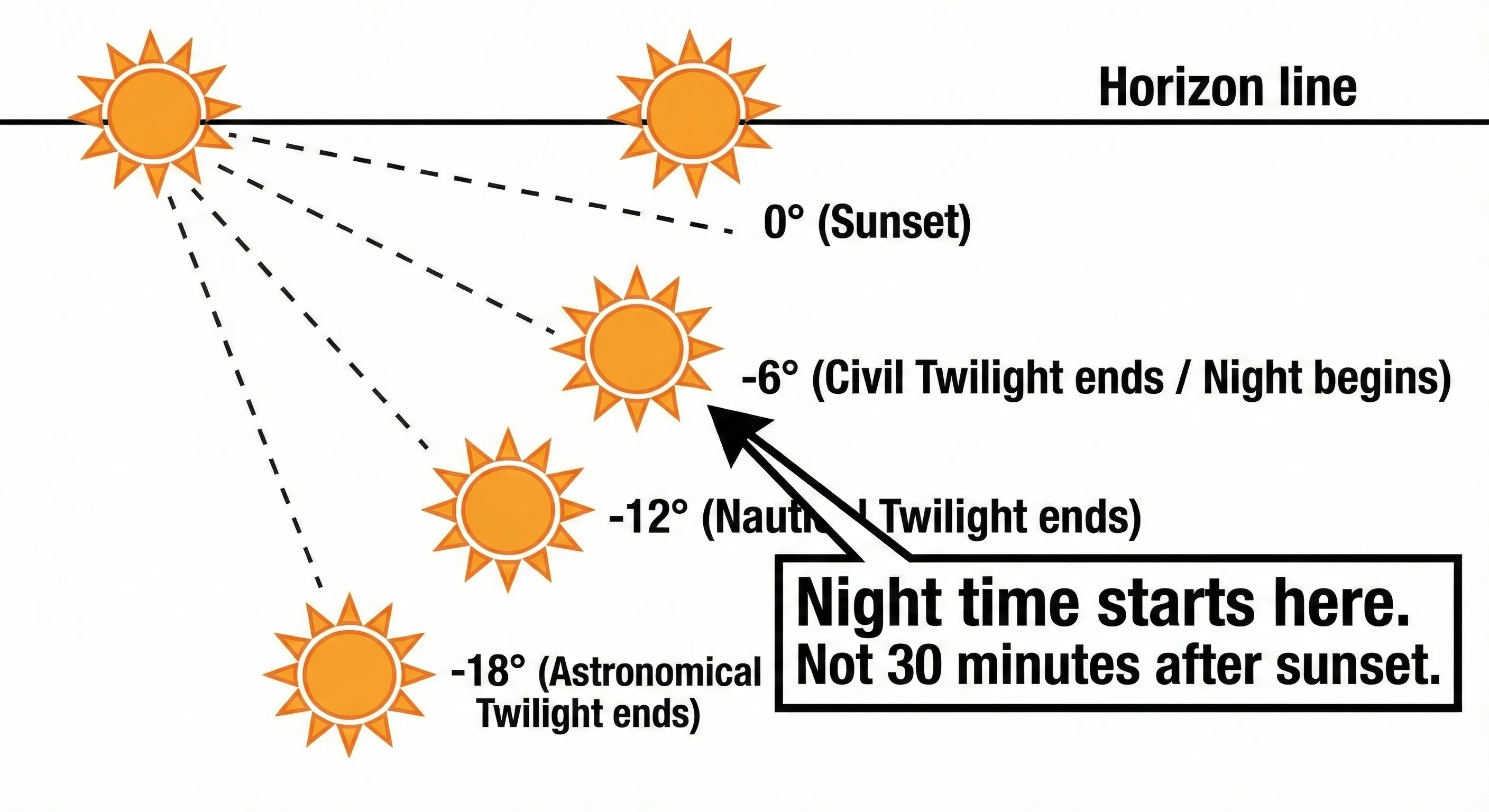
Ask a pilot how to calculate night time, and you’ll probably hear the same answer: 30 minutes after sunset to 30 minutes before sunrise. It’s what most of us were taught. It’s what everyone seems to do.
But it’s not how night is actually defined.
If you’ve been logging night time this way, you’re not alone. But you’re also not accurate. And for pilots building hours toward a career, accuracy matters.
The Myth: +30/-30
The idea is simple. Sunset happens, you wait 30 minutes, night begins. Sunrise approaches, you stop logging night 30 minutes before. Easy to remember, easy to calculate.
The problem is that this rule doesn’t come from any aviation authority’s actual definition of night. It’s a shortcut that spread through flight schools and never got questioned. Somewhere along the way, a convenient approximation became accepted fact.
But night doesn’t care about your watch. Night is an astronomical event, and it varies based on where you are and when you’re flying.
What Night Actually Means
For logging purposes, most aviation authorities define night based on civil twilight. Specifically, night begins when the center of the sun passes 6 degrees below the horizon after sunset, and ends when it rises back to 6 degrees below the horizon before sunrise.
This isn’t arbitrary. At 6 degrees below the horizon, the sky is dark enough that ground objects are no longer clearly visible without artificial light. That’s the practical threshold that matters for flight operations.
The key point: night is defined by the sun’s position relative to the horizon, not by a fixed number of minutes after sunset.
Why the +30/-30 Rule Falls Apart
The time between sunset and civil twilight isn’t constant. It changes based on two factors most pilots never consider.
Latitude matters. Near the equator, the sun drops quickly below the horizon. Twilight is short, maybe 20 to 25 minutes. In northern Europe or Canada, the sun sets at a shallow angle, stretching twilight to 30, 40, even 50 minutes or more. In extreme latitudes during summer, civil twilight can last all night.
Season matters. The same airport has dramatically different twilight durations in January versus July. A winter evening in Stockholm sees darkness arrive fast. A summer evening at the same spot barely reaches night at all.
A pilot flying from Helsinki to Madrid in June might cross through twilight zones that shift by the minute as they travel south. The +30/-30 rule has no way to account for this.
The Real World Impact
How much does this actually affect your logbook? More than you might expect.
On a single flight, the difference between +30/-30 and actual civil twilight might be 10 or 15 minutes. That sounds small until you consider what it means over time.
A pilot logging 500 hours per year with regular evening flights could accumulate hours of inaccurate night time annually. Over a decade, that’s a meaningful discrepancy. If you’re building toward a rating that requires specific night hours, or preparing records for an airline interview, those numbers get scrutinized.
And it’s not just about totals. Your logbook is a legal document. The entries should reflect what actually happened, not a rough approximation based on a rule that someone made up.
The Variables Most Pilots Ignore
Beyond the +30/-30 myth, there’s another layer of complexity that almost nobody accounts for: your position during the flight.
If you depart at dusk and fly for three hours, where you are at the midpoint of that flight affects whether you’re in night conditions. A westbound flight chases the sun, potentially extending daylight. An eastbound flight flies into darkness faster. A northbound flight in summer might stay in twilight the entire time. A southbound flight from Scandinavia in winter drops into night almost immediately.
The accurate way to calculate night time isn’t just about when you depart and arrive. It’s about where you are throughout the flight and what the sun is doing at each point along your route.
Doing this manually is essentially impossible. You’d need solar position data for every waypoint, adjusted for date and latitude. No pilot is pulling out an astronomical almanac after every flight.
How Modern Logbooks Should Handle This
This is exactly the kind of calculation that software should do for you.
A properly designed digital logbook takes your departure point, arrival point, route, date, and times, then calculates the sun’s position along your flight path to determine actual night time. Not an estimate. Not a shortcut. The real number.
Skyden does this automatically. For every flight, it calculates civil twilight based on actual solar positions, checking your location at each point along the route. The night time that appears in your logbook reflects where you actually were and what the sky was actually doing, not a formula someone invented decades ago.
You don’t have to think about it. You log your flight, and the math happens in the background.
What This Means for Your Logbook
If you’ve been using the +30/-30 rule, your historical entries aren’t necessarily wrong. They’re approximations, and for most practical purposes, they’ve probably been close enough.
But going forward, there’s no reason to keep guessing. The technology exists to calculate night time accurately. Using it means your logbook reflects reality, not convention.
For pilots building a career, this matters. Your hours are your credentials. They represent thousands of decisions, thousands of landings, thousands of moments in the cockpit. The details should be right.
Final Thoughts
Night time calculation is one of those topics most pilots never think about. You learn a rule early in training, you apply it for years, and you assume it’s correct because everyone else does the same thing.
But the +30/-30 rule isn’t in any regulation. It’s not how night is defined. It’s a shortcut that stuck around because it was easy, not because it was accurate.
Now you know the difference. Civil twilight, 6 degrees below the horizon, varying by latitude and season and position. That’s what night actually means.
Your logbook should reflect that.
 Prova gratis