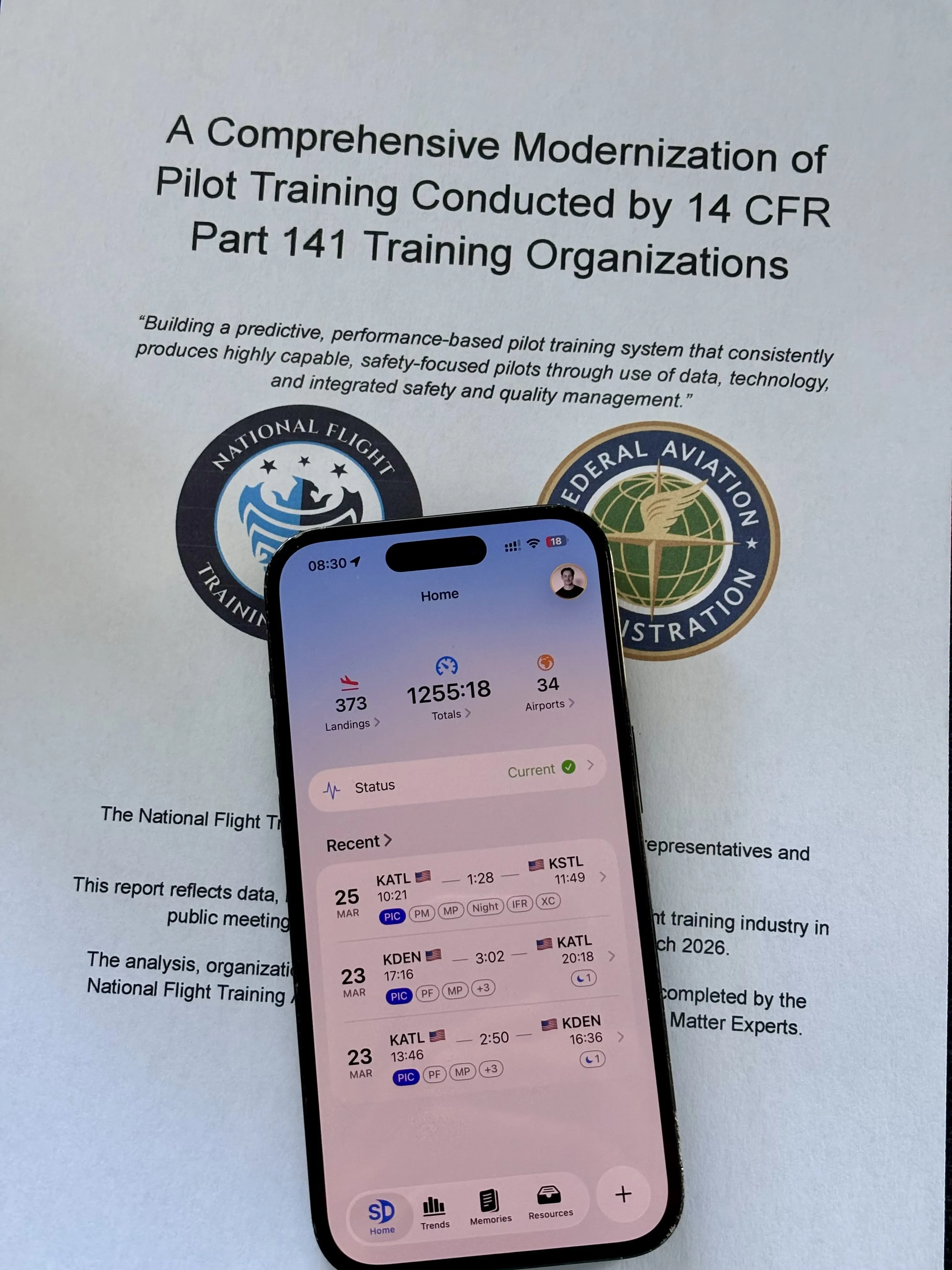
In March 2026, the flight training industry handed the FAA a 471-page blueprint for the most comprehensive overhaul of Part 141 pilot training in over 50 years. The document, submitted by the National Flight Training Alliance (NFTA) through the Federal Register docket FAA-2024-2531-0293, proposes rewriting nearly every aspect of how certificated flight schools operate in the United States.
If you’re a student pilot choosing between Part 61 and Part 141, a career pilot tracking your hours toward an ATP, or a flight instructor working within the 141 system, this proposal could reshape your training path. Here’s what the report actually says, what it would change, and what still needs to happen before any of it becomes regulation.
Why Part 141 Needs an Overhaul
14 CFR Part 141 governs FAA-certificated pilot schools. It sets the standards for curricula, instructor qualifications, examining authority, and oversight. Training under Part 141 lets students earn certificates and ratings with fewer minimum hours than Part 61 requires, in exchange for operating within a structured, FAA-approved program.
The problem: the regulatory framework hasn’t kept pace with the industry it regulates. Part 141 still has foundational ties to the Civil Air Regulations (CAR) Part 50, which was implemented in the 1940s. The last significant revision came in 1997. Since then, pilot production has expanded dramatically, simulation technology has leaped ahead, and international standards under ICAO and EASA have moved toward performance-based oversight models that the U.S. system doesn’t match.
The 2024 FAA Reauthorization Act formally directed the FAA to modernize Part 141. The NFTA, representing flight schools of all sizes, spent a full year of public meetings from March 2025 through March 2026, gathering input from across the training industry. The result is eight principal recommendations, each backed by proposed regulatory language.
The Numbers That Frame the Problem
Before diving into the recommendations, a few data points from the report help explain why the current system frustrates everyone involved:
- 509 certificated Part 141 pilot schools exist in the United States
- Only 74 of those (15%) hold examining authority, meaning they can issue certificates without requiring an external DPE practical test
- 80 FSDOs across 77 geographical areas are responsible for oversight, each operating with a degree of autonomy that creates inconsistency
- A training syllabus approved in one FSDO district can be rejected in another, forcing schools to navigate what the report calls the “FSDO lottery”
- Syllabus amendments can sit on a Principal Operations Inspector’s desk for 6 months or longer, during which the school is stuck teaching a curriculum it knows needs updating
The report doesn’t just identify these as annoyances. It argues that FSDO inconsistency and administrative delays are actively discouraging flight schools from seeking Part 141 certification, undermining the very safety framework the regulation is supposed to promote.
The 8 Recommendations Explained
1. A Central Management Office for Part 141
The most structurally significant proposal. Instead of 80 FSDOs independently overseeing Part 141 schools, a single Central Management Office (CMO) would handle all initial certifications, syllabus approvals, and examining authority decisions. Local FSDOs would still conduct inspections, but all decision-making would be centralized.
The FAA already uses this model for Designated Pilot Examiners and Part 135 operators. The report argues it would eliminate the inconsistency where your school’s fate depends on which FSDO you’re assigned to. The CMO would also enforce a 30-day Service Level Agreement for FSDO-delegated tasks, ending the indefinite delays that currently plague the system.
What it means for pilots: Faster school certifications, more consistent standards nationwide, and fewer situations where your training gets disrupted by administrative bottlenecks between your school and the FAA.
2. Mandatory Safety and Quality Management Systems
The U.S. has filed a formal difference with ICAO because Part 141 doesn’t require Safety Management Systems (SMS) or Quality Management Systems (QMS). These are standards that ICAO Annex 1 and Annex 19 mandate for all approved training organizations. The FAA already requires SMS for Part 135 and Part 121 operators. Part 141 schools are the gap.
The proposal introduces a two-tier QMS structure:
- Tier 1: The school demonstrates it has a documented QMS with defined processes for internal audits, data collection, and corrective action. It operates under traditional FAA approval workflows.
- Tier 2: The school proves its QMS is actively driving measurable improvements in safety and training quality. Tier 2 schools gain significant autonomy, including the ability to implement curriculum changes through notification rather than formal approval.
What it means for pilots: Schools with mature quality systems would operate more like airlines: data-driven, self-correcting, and less dependent on biennial paperwork audits. For students, this could mean training at schools that adapt faster to better methods.
3. Modernized Oversight and Documentation
Currently, Part 141 schools must undergo a full certificate renewal every 24 months. The report calls this a “hard reset” that consumes resources for both the school and the FAA while providing only a snapshot of compliance. The proposal replaces this with continuous currency tied to QMS performance.
It also consolidates all school documentation into a single Pilot Training Management Manual (PTMM), separating institutional information (facilities, fleet, personnel policies) from course-specific curricula. Today, adding a new aircraft tail number can require amending every single Training Course Outline. That redundant process burns administrative time on both sides.
What it means for pilots: Less bureaucratic overhead for schools means they can focus resources on training quality rather than renewal paperwork. The PTMM consolidation is an administrative change, but it directly affects how quickly schools can update their programs.
4. Industry Consensus Standards
Rather than waiting for the FAA to update prescriptive regulations (a process that takes years), the proposal creates a path for industry-developed consensus standards as an alternate means of compliance. Think of it as a faster mechanism for adapting Part 141 to evolving best practices without requiring full rulemaking.
What it means for pilots: Training methods could evolve faster. If the industry develops better approaches to, say, scenario-based instrument training, they wouldn’t have to wait for a formal rule change to implement them.
5. Examining Authority Reform
Only 74 of 509 Part 141 schools hold examining authority, the privilege that lets a school conduct end-of-course tests in lieu of an external DPE practical test. The current system ties this privilege primarily to an 80%/90% first-time pass rate. The report calls this metric “blunt and often misleading” because it doesn’t account for student demographics, DPE variability, or the depth of the training environment.
The proposed changes:
- Examining authority would be tied to Tier 2 QMS status rather than pass-rate statistics alone
- Check instructors would receive standardized training comparable to DPEs, including access to the FAA’s DPE training curriculum
- Mandatory recurrent training within 12 months for all check instructors
- The report cites research (Knecht & Smith, 2012) showing no statistically significant difference in subsequent safety outcomes between pilots certificated through Part 141 examining authority and those evaluated by DPEs
What it means for pilots: More schools could gain examining authority, reducing reliance on the overloaded DPE network. That means shorter wait times for checkrides and a more streamlined path to your certificate.
6. Expanded Simulator and Technology Credit
This is where the proposal gets most tangible for student pilots. The current simulator credit limits date back to a 1997 revision and a 2014 policy change that actually reduced some previously allowed credits. The NFTA argues these caps no longer reflect what modern simulation can deliver.
Key proposed changes:
| Device | Private | Instrument | Commercial | ATP | CFI |
|---|---|---|---|---|---|
| Full Flight Simulator | 65% | 80% | 50% | 100% | 80% |
| FTD Level 6/7 | 60% | 70% | 45% | 80% | 60% |
| EAATD (new category) | 50% | 60% | 40% | 45% | 50% |
| AATD | 25% | 40% | 30% | 25% | 35% |
| Extended Reality (XR) | 10% | 15% | 15% | 15% | 15% |
The report also proposes a new Enhanced Advanced Aviation Training Device (EAATD) category, bridging the gap between current AATDs and Level 5 FTDs. An EAATD would require make-and-model fidelity (think a G1000-equipped Cessna 172S simulator with 210-degree visuals) and would carry credit comparable to an FTD Level 5.
Extended Reality (XR), including VR, AR, and mixed reality, would receive formal regulatory recognition for the first time, with its own credit allowances.
The report cites research showing students in intensive simulator-based programs earned FAA Private Pilot certificates in approximately 39% fewer aircraft hours than conventionally trained counterparts (Lubner et al., 2015). A separate study found VR-trained instrument students significantly outperformed a no-training control group (Guthridge & Clinton-Lisell, 2023).
What it means for pilots: More of your training time in simulators could count toward your certificate, potentially lowering training costs significantly. A Full Flight Simulator could cover 100% of ATP and CFI refresh requirements. Even lower-tier devices like AATDs would see meaningful credit increases.
7. New Training Courses and Appendix Updates
The current Part 141 appendices are paradoxically more restrictive than Part 61 in several areas, creating what the report calls a “regulatory penalty” for choosing the structured path. The proposal addresses this with targeted updates and entirely new course appendices.
Professional Pilot Track (new Appendix P): An integrated pathway combining Private, Instrument, Commercial, and Commercial Add-On into a cohesive 200-hour minimum program. Instead of treating these as four isolated courses with rigid hour requirements, the Professional Pilot Track lets schools allocate hours strategically across the entire progression, provided all ACS requirements and certification eligibility standards are met.
The curriculum adds professional competencies beyond ACS minimums: CRM, SOPs, threat-and-error management, automation management, and scenario-based decision-making. Each school offering the Track must maintain an Industry Advisory Board with airline and corporate aviation representatives who provide feedback on graduate readiness.
Other new appendices include the ATP Certification Training Program (ATP-CTP) as a standalone, the Enhanced Qualification Program (EQP) for Restricted ATP pathways, and a Consensus Standards appendix.
Existing appendix updates include removing outdated cross-country requirements for additional class ratings, reducing MEI flight hours from 25 to 15, and replacing specific task lists with references to current Airman Certification Standards.
What it means for pilots: The Professional Pilot Track could streamline the zero-to-commercial journey significantly, reducing redundancy and aligning training with what airlines actually want to see. Updated appendices would remove some of the bureaucratic quirks that currently make Part 141 less appealing than Part 61 for certain ratings.
8. Registered Pilot School
The current “provisional pilot school” certification is nearly as burdensome as full Part 141 certification, which defeats its purpose as an on-ramp. The proposal replaces it with a Registered Pilot School category: a lightweight registration that gives FAA recognition without full Part 141 privileges.
A Registered Pilot School would operate under Part 61 requirements, couldn’t claim to be “FAA-certified,” and wouldn’t have examining authority. But it would establish a formal relationship with the FAA, making the eventual step to full certification less daunting.
What it means for pilots: More schools in the system, even at a basic level, means more training providers operating with at least some FAA visibility. For students at registered schools, it signals the school is working toward Part 141 standards.
What the U.S. Is Catching Up On
The report is candid about where the U.S. lags behind international standards. EASA has required quality management systems for approved training organizations for years. ICAO’s Standards and Recommended Practices (SARPs) under Annex 1 and Annex 19 mandate both SMS and QMS for training organizations. The U.S. has formally filed a difference with ICAO because Part 141 doesn’t comply.
The proposed CMO model mirrors how many EASA member states centralize their ATO oversight. The expanded simulator credits would bring U.S. allowances closer to what EASA already permits for approved FSTD usage. And the Professional Pilot Track bears structural similarities to EASA’s integrated ATPL programs, where training from PPL through CPL is treated as a single coordinated curriculum.
This isn’t about copying the European model. The U.S. bifurcated system of Part 61 and Part 141 is structurally different from EASA’s ATO framework. But the report argues the U.S. can meet international standards within its own regulatory architecture.
What Hasn’t Changed Yet
It’s important to be clear about what this report is and isn’t. The NFTA report is an industry proposal submitted to the FAA, not a final rule. Here’s what still needs to happen:
- FAA review: The General Aviation and Commercial Division will determine which recommendations to pursue
- Notice of Proposed Rulemaking (NPRM): If the FAA moves forward, it must publish proposed rules for public comment
- Public comment period: Typically 60-90 days for aviation rulemaking
- Final rule: After considering comments, the FAA publishes the final regulation
- Implementation: Schools need time to adapt to new requirements
This process typically takes years, not months. Some recommendations (like the CMO) could potentially be implemented through internal FAA policy changes faster than others that require full rulemaking (like the simulator credit increases).
The 2024 FAA Reauthorization Act directed this modernization, which gives the effort Congressional backing. But regulatory timelines in aviation are unpredictable, and the final rules may look different from what the NFTA proposed.
What to Watch For
If you’re currently in training or planning to start, don’t delay decisions based on potential future rules. Train under the regulations that exist today. But here’s what’s worth following:
- Simulator credit changes would have the most immediate financial impact on students. Higher credit percentages mean more training in simulators (typically $50-100/hour) rather than aircraft ($200-400/hour).
- The Professional Pilot Track could change how flight schools structure career programs. If you’re choosing a Part 141 school, ask whether they’re tracking these developments.
- Examining authority expansion could ease the DPE bottleneck that currently adds weeks or months to the certification timeline in many parts of the country.
- The CMO proposal would address the FSDO inconsistency that frustrates schools and, by extension, their students.
For context on current FAA logbook requirements and how they interact with training records, or how these requirements compare to EASA’s framework, we’ve covered both in detail.
Key Takeaways
- The NFTA submitted a comprehensive 471-page Part 141 modernization proposal to the FAA in March 2026, the first major overhaul effort in over 50 years
- The eight principal recommendations cover centralized oversight, safety management systems, expanded simulator credits, examining authority reform, and new training pathways
- Proposed simulator credit increases could significantly reduce training costs, with up to 100% FFS credit for ATP programs
- A new Professional Pilot Track would create an integrated 200-hour pathway from PPL through Commercial with multi-engine add-on
- The U.S. would move closer to ICAO/EASA alignment on SMS, QMS, and technology integration
- This is an industry proposal, not a final rule. Full implementation requires FAA rulemaking that will take years.
- Current regulations remain in effect. Don’t change your training plans based on proposals that haven’t been adopted.
The full NFTA report is available on the Federal Register docket for anyone who wants to dig into the 471 pages of proposed regulatory language. For most pilots, the practical impact will come down to whether the FAA follows through, and how closely the final rules match the industry’s vision.
 Prova gratis