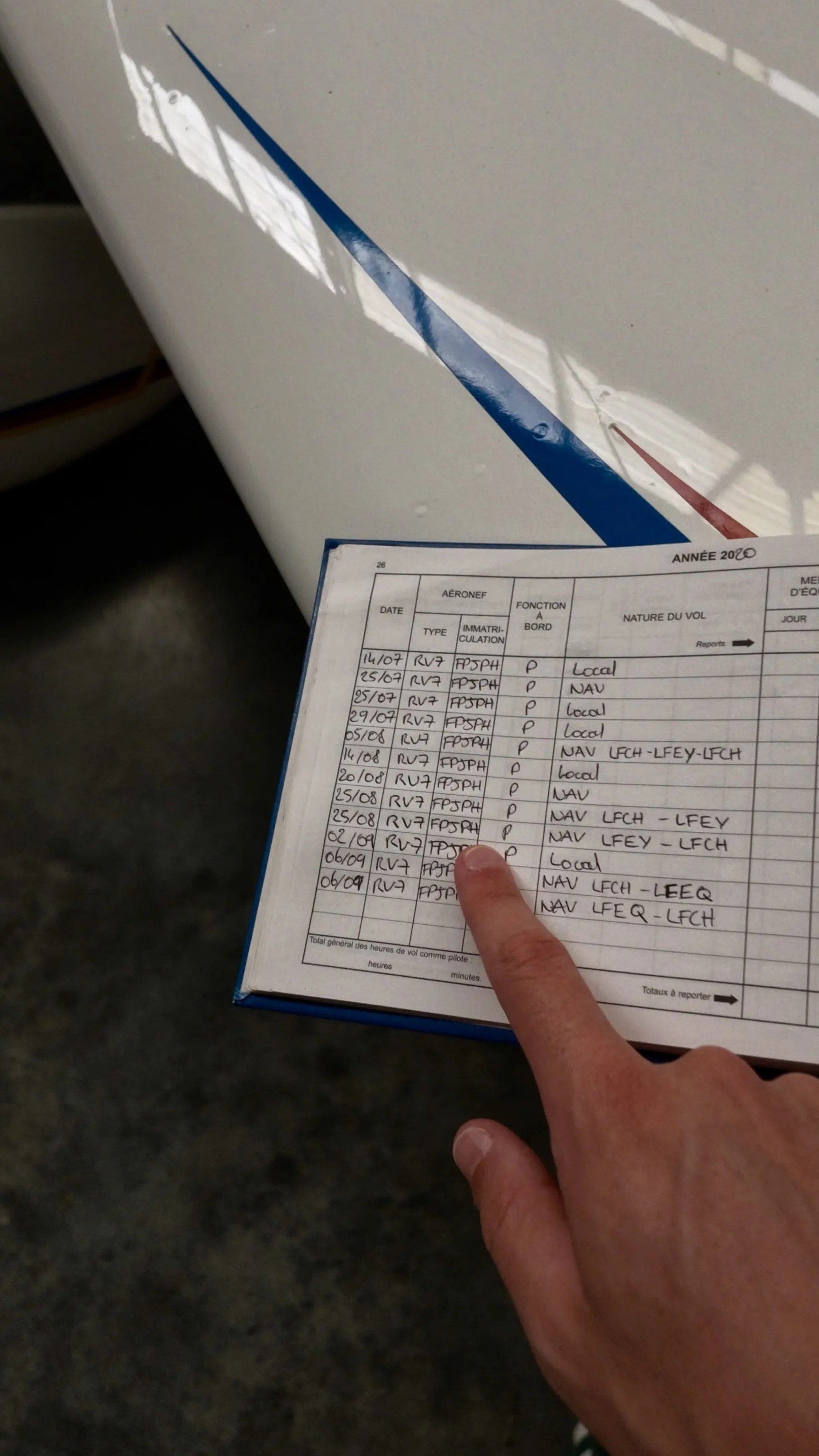
You fly a multi-crew leg from London to New York. You hand-fly the approach, make the landing, and open your logbook. Under EASA, on an ordinary line flight, the designated commander logs PIC time and the other pilot logs co-pilot time unless a specific PICUS, SPIC, check, or PIC-under-supervision rule applies. Under the FAA, a rated pilot may log PIC for the time they are the sole manipulator of the controls, regardless of who was acting as PIC.
Same flight. Same pilot. Different PIC hours depending on which authority’s rules you follow.
If you hold licences from both EASA and the FAA, or you’re considering an international career, understanding these differences isn’t optional. Your logbook is your career record, and getting the entries wrong under either system creates problems that are painful to fix later.
This comparison focuses on how each authority expects you to record flights, rather than on licensing or training requirements.
TL;DR
- EASA requires a reliable record of every flight. FAA rules require logging when time supports a certificate, rating, flight review, or currency requirement.
- EASA PIC time generally follows designated function and specific supervised cases. FAA rules can let a rated sole manipulator log PIC even when another pilot acts as PIC.
- EASA defines night for logging through civil twilight. FAA night passenger currency uses a separate window from 1 hour after sunset to 1 hour before sunrise.
- EASA cross-country time has no fixed distance threshold. FAA thresholds vary by certificate, rating, purpose, and aircraft category.
- Both authorities accept non-paper records, but EASA specifies an electronic-logbook format while FAA Part 61 remains format-neutral.
- Dual-authority pilots should preserve enough detail for both systems and calculate PIC time under each authority’s rules.
The Fundamental Difference in Philosophy
The two authorities start from different assumptions about what a pilot must record.
EASA requires you to log every flight. FCL.050 states that “the pilot shall keep a reliable record of the details of all flights flown.” No exceptions. Every flight gets an entry.
The FAA only requires logging when you need to prove something. 14 CFR 61.51 mandates documenting “training and aeronautical experience used to meet the requirements for a certificate, rating, or flight review” and “the aeronautical experience required for meeting the recent flight experience requirements.” A VFR pleasure flight with no currency implications? Technically not required to be logged.
Should you log everything under the FAA anyway? Absolutely. But the regulatory obligation is narrower than most pilots assume.
This philosophical difference carries through to every aspect of how the two systems handle logbook entries.
Required Logbook Fields: Side by Side
EASA’s current AMC1 FCL.050 sets out a 12-column standard logbook format. The FAA requires fewer fields under 14 CFR 61.51(b):
| Field | EASA | FAA |
|---|---|---|
| Date | Required | Required |
| Departure place and time | Required (ICAO + UTC) | Place required, time not specified |
| Arrival place and time | Required (ICAO + UTC) | Place required, time not specified |
| Aircraft type and registration | Make, model, variant + registration | Type and identification |
| SP/MP and SE/ME | Required in the standard format | Not required |
| Total flight time | Required | Required |
| PIC name | Required (“SELF” or name) | Not required |
| Landings (day/night split) | Required | Not required (but needed for currency proof) |
| Night time | Required (column 9) | Day or night condition required |
| IFR time | Required (column 9) | Actual/simulated instrument required |
| Pilot function time | PIC (including solo/SPIC/PICUS), co-pilot, cruise-relief co-pilot, dual, FI, or FE | Solo, PIC, SIC, or training received |
| FSTD sessions | Required (type, qual number, date, duration) | Required if used for currency/certificates |
| Remarks/endorsements | Required where applicable (PICUS/SPIC sigs, skill tests, proficiency checks, CRCP) | Required for training endorsements and some instrument/currency records, but not a general field |
| Safety pilot name | Not an FCL.050 logbook field | Required when a safety pilot is required |
The biggest structural differences: EASA requires the SP/MP classification, the PIC’s name, and a specific split of landings by day and night. The FAA doesn’t require any of those fields but does require the safety pilot’s name when one is required under its rules.
For a deep dive on each system individually, see our guides on EASA logbook requirements and FAA logbook requirements.
PIC Time: The Biggest Difference
This is where the two systems diverge the most, and where pilots flying under both authorities get into trouble.
Under EASA, PIC time is tied to the logging cases in AMC1 FCL.050, not to who touched the controls. You log PIC when you are the designated pilot-in-command of the flight, when you are flying solo, when you are acting as an instructor or examiner, when you successfully complete certain tests/checks/assessments with the required countersignature, when you are flying as PICUS or SPIC with the appropriate countersignature, or when a specific PIC-under-supervision rule requires both pilots to log PIC.
Under the FAA, PIC time is often tied to the sole manipulator rule. A sport, recreational, private, commercial, or airline transport pilot may log PIC when they are the sole manipulator of the controls of an aircraft for which they are rated, even if someone else is acting as PIC. The FAA also has separate PIC logging paths for acting PIC in operations requiring more than one pilot, flight instructors, and approved PIC-under-supervision programs. This means multiple pilots can log PIC simultaneously on the same flight when each meets a separate logging rule.
Consider a four-hour A320 flight:
Scenario: A captain and first officer fly a 4-hour leg in an A320. Assume both pilots hold the FAA certificates and ratings needed for the aircraft, and the first officer is qualified to log SIC. The first officer hand-flies the departure and approach (1.5 hours total). The captain is the designated PIC for the entire flight.
| EASA | FAA | |
|---|---|---|
| Captain PIC time | 4:00 | 4:00 (acting PIC) |
| Captain co-pilot time | 0:00 | 0:00 |
| First officer PIC time | 0:00 | 1:30 (sole manipulator) |
| First officer co-pilot time | 4:00 | 2:30 |
Under EASA, absent PICUS or another specific PIC logging basis, the first officer logs 4 hours of co-pilot time and zero PIC. Under the FAA, the same first officer logs 1.5 hours of PIC (for the portions they hand-flew as sole manipulator) and 2.5 hours of SIC. The total hours are the same, but the split between PIC and SIC/co-pilot is completely different.
This distinction matters enormously for pilots building PIC hours toward an ATPL or airline minimums. A first officer with 3,000 FAA hours might have 1,500 hours of PIC under FAA rules but only 200 hours of PIC under EASA rules (from PICUS time and any flights where they were designated commander). When applying to a European airline, it’s the EASA number that counts.
Night Time: Logging vs Currency
Both authorities require night-related records, but not in the same way.
EASA defines night based on civil twilight: the period between the end of evening civil twilight and the beginning of morning civil twilight, unless the appropriate authority prescribes another sunset-to-sunrise period. The duration of twilight varies significantly by latitude and season. A flight departing Helsinki in December enters night conditions much faster than the same flight in June.
The FAA Part 61 logbook rule requires you to record whether the condition of flight was day or night. For passenger currency, Part 61 is more specific: 1 hour after sunset to 1 hour before sunrise.
| EASA logging | FAA Part 61 logbook entry | FAA passenger currency | |
|---|---|---|---|
| What the regulation text says | Night if the operation takes place between evening and morning civil twilight, unless another competent-authority period applies | Record day or night as a condition of flight | 1 hour after sunset to 1 hour before sunrise |
The practical point for a dual-authority logbook is that EASA night time and FAA night passenger currency cannot be treated as the same field. EASA requires night time in the logbook format. FAA Part 61 requires day/night condition entries and separately defines the night passenger-currency window.
For a full breakdown of how night calculations work (and why the +30/-30 shortcut is wrong), see our guide on how night time is actually calculated.
Cross-Country Time: One Term, Two Meanings
EASA defines cross-country simply as “a flight between a point of departure and a point of arrival following a pre-planned route, using standard navigation procedures.” There is no minimum distance. A 20-nautical-mile flight from one airport to another qualifies.
The FAA has multiple distance thresholds depending on the certificate:
| Certificate/Rating Purpose | FAA Cross-Country Minimum |
|---|---|
| General Part 61 logging definition | Landing at a point other than departure, using navigation to get there |
| Private/commercial/instrument, except rotorcraft and powered parachute cases | Landing >50 nm from departure point |
| Rotorcraft category or instrument-helicopter | Landing >25 nm from departure point |
| Sport pilot, except powered parachute | Landing >25 nm from departure point |
| Sport powered parachute or private powered parachute | Landing >15 nm from departure point |
| ATP, except rotorcraft | Point >50 nm from departure; no landing required |
Under 14 CFR 61.1, the FAA also recognizes a broader definition of cross-country for general logging: a flight by a certificate holder in an aircraft that includes a landing at a point other than the departure point and uses navigation to get there. But for meeting specific certificate requirements, the distance thresholds above apply.
EASA doesn’t even use cross-country as a standalone time category in the logbook. It matters for certain training requirements (like the cross-country qualifying flight for the PPL), but it’s not a column you track.
Pilot Function Categories
EASA and the FAA categorize pilot roles differently, and the categories don’t map one-to-one.
EASA pilot function time includes:
- PIC (including solo, SPIC, PICUS, and specific PIC-under-supervision cases)
- Co-pilot, including cruise-relief co-pilot
- Dual instruction received
- Instructor or examiner time
You cannot turn pilot-flying time into PIC time just because you handled the controls. A student receiving instruction logs dual time, not PIC time, unless flying as SPIC with a countersignature. Instructor time is the important exception to the simple “one role only” shorthand: AMC1 FCL.050 says instructor time should be recorded as appropriate and also entered as PIC.
FAA pilot experience types under 61.51(b)(2):
- Solo
- PIC
- SIC (Second in Command)
- Flight training received
These categories can overlap. A rated pilot receiving instruction can also log PIC time if they meet the sole-manipulator rule. A safety pilot may log SIC, or PIC if designated as acting PIC, when the applicable §61.51 conditions are met.
EASA also requires pilots to record single-pilot (SP) and multi-pilot (MP) time in the standard format, further splitting SP into single-engine and multi-engine where applicable. The FAA has no equivalent logbook field.
Electronic Logbooks: EASA Explicit, FAA Format-Neutral
Both authorities can support non-paper records, but the regulatory text handles them differently.
EASA has accepted electronic logbooks in AMC1 FCL.050 since ED Decision 2020/005/R, dated 18 March 2020, and the current AMC1 FCL.050 keeps that acceptance. Your electronic record must contain the relevant AMC1 FCL.050 items, be readily available for inspection, be certified by the pilot, and be in a format acceptable to the competent authority. Some national authorities within EASA may have additional preferences, so check with your local CAA.
The FAA Part 61 logbook rule does not prescribe a paper logbook. It requires the relevant time to be documented and recorded in a manner acceptable to the Administrator, and it requires records to be presented on reasonable request.
Both systems agree on one thing: whatever format you use, you need to be able to produce your records when asked.
Flying Under Both Authorities
If you hold both EASA and FAA licences, you have two options for your logbook.
Option 1: Maintain two separate logbooks. One follows EASA formatting, the other follows FAA formatting. This is the cleanest approach from a compliance standpoint but doubles your workload.
Option 2: Maintain one logbook that satisfies both systems. This is where most dual-authority pilots land. It works, but only if your logbook captures every field that either system requires. You need the EASA 12-column structure plus the FAA-specific fields (safety pilot name, approach details for currency). And you need to track PIC time under both definitions, because a single number can’t represent both systems accurately.
Practical tips for dual-authority pilots:
- Track PIC time separately for each authority. Your FAA PIC total will often be higher than your EASA PIC total. Both numbers need to be accurate and defensible.
- Use the stricter format as the baseline. EASA’s 12-column structure is more detailed than the FAA’s required entry fields, but you still need to add FAA-specific details such as approach types and safety pilot names.
- Be consistent with times. EASA expects UTC for departure and arrival. If your combined logbook uses UTC as the baseline, do not mix local times into the same fields.
- Document PICUS/SPIC properly. If you’re building EASA PIC time through PICUS or SPIC, the required countersignature needs to be in the remarks. Missing signatures make that EASA PIC claim hard to defend.
How Skyden Handles Multi-Authority Logbooks
The same flight needs different outputs depending on which authority reviews the logbook. Entering it twice or maintaining parallel records creates extra work and more opportunities for discrepancies.
Skyden works fully offline, provides encrypted automatic backup, and uses extensive automation for daily entries. Monthly and annual subscriptions unlock the same complete feature set. Night time is calculated from solar positions along your route, as explained in our night-time calculation guide, for EASA civil-twilight records and FAA passenger-currency windows.
When you need to export, Skyden generates dedicated PDF layouts for 7 authorities (EASA, FAA, TCCA, UK CAA, JCAB, GCAA, CASA) from the same underlying data. Each layout applies the relevant column structure and time categories. The pilot remains responsible for classifying PIC and other time under the rules governing each record.
Get your first 20 flight hours free to check Skyden against the records and exports you use under each authority. Every feature is available during your first 20 free flight hours.
 Try Skyden Free