
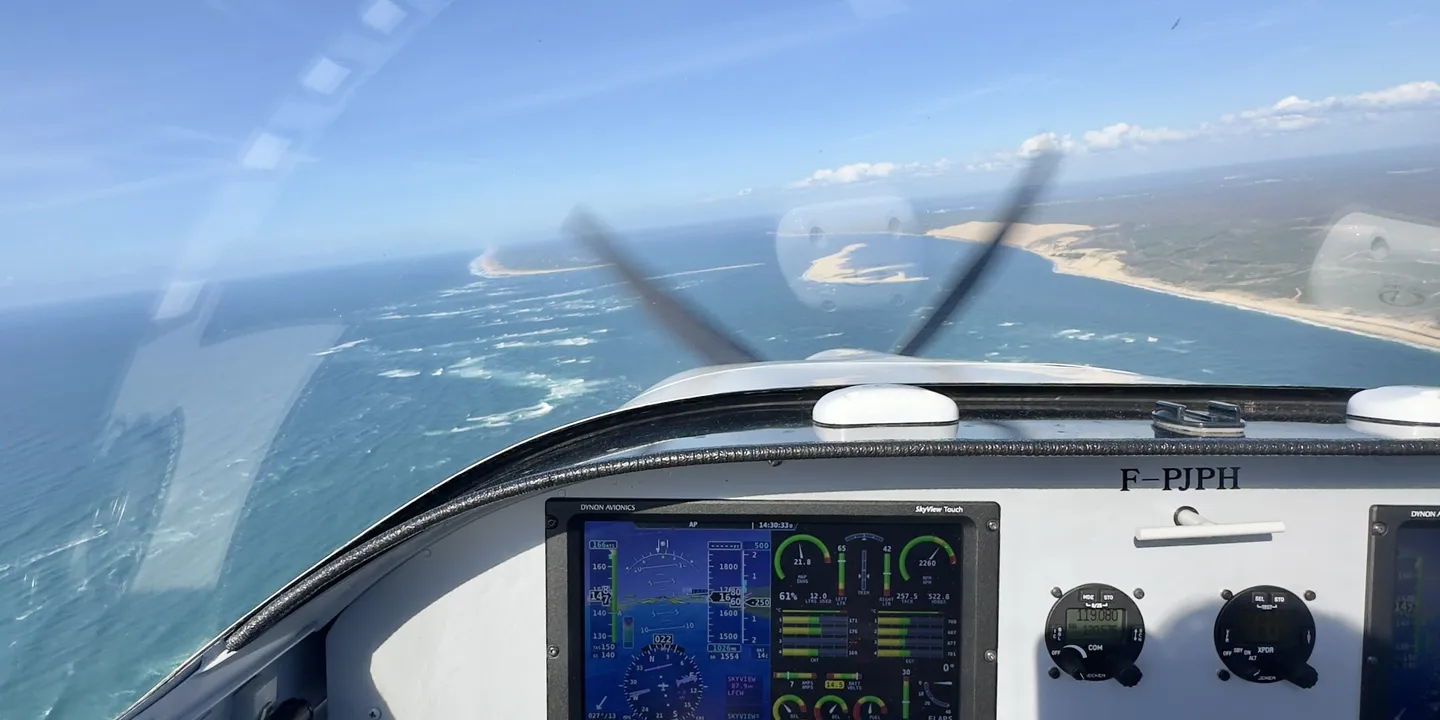
You fly 1.4 hours from your home airport, land 42 NM away, and return. Can you log cross-country time? Yes for one purpose, no for another. Change the goal from general experience to an airplane instrument rating and the same flight stops counting toward the required hours.
That is the source of most FAA cross-country mistakes. There is no single distance test. 14 CFR §61.1 defines cross-country time several ways, then ties each definition to a particular certificate, rating, privilege, or category.
Before writing anything in the cross-country column, ask one question: What will I use this time for?
TL;DR
- The FAA has seven cross-country subparagraphs in §61.1(b)(3), not one universal 50 NM rule.
- General cross-country time requires a landing somewhere other than the departure point and the use of navigation. It has no minimum distance.
- For most airplane private, commercial, and instrument aeronautical experience, the flight must include a landing more than 50 NM straight-line from the original point of departure and use navigation.
- Sport pilot and rotorcraft experience generally use 25 NM. Powered-parachute experience uses 15 NM.
- ATP airplane cross-country requires flight more than 50 NM straight-line from the original departure point, but it does not require a landing there.
- When a discrete flight qualifies, use FAA flight time under §1.1. Do not count airborne time only or subtract the portion inside 50 NM.
- Multi-leg flights can qualify without any individual leg exceeding 50 NM, provided one landing point is more than 50 NM from the original point of departure.
Why one flight can produce two answers
Suppose you depart Airport A, navigate to Airport B 42 NM away, land, and return to A.
Under the general definition in §61.1(b)(3)(i), the flight is cross-country. You hold a pilot certificate, flew an aircraft, used navigation, and landed somewhere other than your departure point. There is no distance floor.
If you want to credit that time toward the airplane cross-country experience required for a private or commercial certificate or an instrument rating, it does not qualify. The applicable definition requires a landing more than 50 NM straight-line from the original departure point.
Both answers are correct because they answer different questions. A logbook can therefore contain:
- Total cross-country time under the general definition
- Cross-country time eligible for a specific certificate or rating under a narrower definition
Many pilots keep one cross-country total and audit it against the narrower rule when preparing an application. Others use custom fields or tags for more-than-50-NM, rotorcraft, or ATP credit. Either system can work if the underlying entries preserve enough route detail to verify the totals.
The seven FAA cross-country definitions
The regulation is easier to use as a decision table than as a paragraph of legal text.
| Purpose under §61.1(b)(3) | Distance | Landing required? | Navigation required? |
|---|---|---|---|
| General cross-country time | None | Yes, away from departure | Yes |
| Private, commercial, or instrument experience, except listed category exceptions | More than 50 NM | Yes, at the qualifying point | Yes |
| Sport pilot, except powered parachute | More than 25 NM | Yes, at the qualifying point | Yes |
| Sport powered parachute or private powered-parachute rating | More than 15 NM | Yes, at the qualifying point | Yes |
| Rotorcraft certificate or instrument-helicopter experience | More than 25 NM | Yes, at the qualifying point | Yes |
| ATP certificate, except rotorcraft | More than 50 NM | No | Yes |
| Qualifying military pilot seeking commercial certification under §61.73, except rotorcraft | More than 50 NM | No | Yes |
These are definitions of cross-country time. Individual training requirements can add total route distance, minimum flight duration, full-stop landings, a number of landing points, or a particular type of operation. Meeting the §61.1 definition does not prove that you have completed every element of a required training flight.
General cross-country time
The broad definition in §61.1(b)(3)(i) applies unless one of the more specific paragraphs controls. It requires:
- A person who holds a pilot certificate
- Flight in an aircraft
- A landing at a point other than the departure point
- Use of dead reckoning, pilotage, electronic navigation aids, radio aids, or another navigation system to reach that point
There is no minimum distance. A short flight between neighboring airports can be general cross-country time if it meets the definition.
A flight that wanders 200 NM from home and returns without landing anywhere else does not meet this general definition. Distance alone cannot replace the landing.
The more-than-50-NM definition
Section 61.1(b)(3)(ii) is the definition most airplane pilots meet during certificate and rating training. It applies to aeronautical experience for most private and commercial pilot certificates and instrument ratings, with stated exceptions for rotorcraft and powered parachutes.
The flight must:
- Use an appropriate aircraft
- Include a landing point more than 50 NM straight-line from the original departure point
- Use navigation to reach that landing point
The number is more than 50 NM. A calculated distance of exactly 50.0 NM does not clear that wording. Leave enough margin for differences in airport reference points, rounding, and the tool used to calculate the distance.
Sport, powered-parachute, and rotorcraft thresholds
The 50 NM number is not universal across aircraft categories:
- Most sport pilot aeronautical experience uses more than 25 NM.
- Sport powered-parachute and private powered-parachute experience uses more than 15 NM.
- Rotorcraft certificate and instrument-helicopter experience uses more than 25 NM.
Specific aeronautical experience sections may impose different total-distance or segment requirements for a particular flight. Read the applicable certificate paragraph alongside the §61.1 definition.
ATP cross-country works differently
For an ATP certificate other than a rotorcraft category rating, §61.1(b)(3)(vi) requires flight that travels more than 50 NM straight-line from the original point of departure and uses navigation. It does not require a landing away from the departure point.
An ATP applicant can therefore receive cross-country credit for a flight that travels far enough from the original departure point and returns without an intermediate landing, assuming the other requirements are met.
There is also no current §61.159 requirement for one special 500 NM cross-country with three stops. Section 61.159(a)(1) requires 500 hours of cross-country time for an airplane ATP. Do not turn the required total into a fictional single flight.
How to measure the distance
For the definitions with a distance threshold, the FAA uses straight-line distance. Actual track miles do not control.
If two airports are 48 NM apart, flying around weather and covering 75 NM does not make the landing more than 50 NM from the original departure point. Measure between the relevant points, not along the magenta line or the route recorded by GPS.
Use airport coordinates and a reliable great-circle calculation. For a landing away from an airport, preserve the location with enough detail to support the distance. Because §61.1 says more than the threshold, avoid routes sitting on the boundary.
The private pilot long solo flight adds another distance test. Under §61.109(a)(5)(ii), an airplane applicant needs 150 NM total distance, full-stop landings at three points, and one segment with more than 50 NM straight-line between its takeoff and landing locations. That segment test belongs to the specific flight requirement. It is not the basic definition for every cross-country entry.
What is the original point of departure?
The original point of departure belongs to the flight, not automatically to every leg. A landing does not force the next airport to become a new original point.
The FAA’s Sisk interpretation confirms that a multi-leg cross-country can contain several short legs. At least one landing must be more than 50 NM straight-line from the original departure point, but no individual leg has to exceed 50 NM.
Consider this route:
| Route | Distance from original departure A | Result |
|---|---|---|
| A to B | 28 NM | B does not meet the 50 NM test |
| B to C | 34 NM | The leg is short, but C is 58 NM from A |
| C to A | 58 NM | Return leg |
If A is the original departure and the route is one discrete flight, the landing at C satisfies the more-than-50-NM condition. The fact that A to B and B to C are each shorter than 50 NM does not matter.
A landing does not automatically reset the flight
The Van Zanen interpretation says §61.1 does not dictate how separate flights must be logged. A pilot may determine what is a flight and what is a segment, then log the time appropriately when the operation is conducted.
That flexibility does not make the choice meaningless. Independent flights can have independent original departure points. Several planned legs can be one cross-country flight. Preserve the routing and make the grouping understandable rather than relying on an unexplained total months later.
Do not use the number of logbook rows as the legal test. One row can summarize several legs, while an electronic logbook may display each leg separately. What matters is the flight, its original departure point, its qualifying landing or distance, and the purpose for which you claim the time.
Does an A-B-A flight count?
Returning home does not erase an intermediate landing.
If B is more than 50 NM straight-line from A, an A-B-A flight can satisfy the §61.1(b)(3)(ii) definition, assuming it uses navigation and meets the other conditions. It includes a landing at B more than 50 NM from the original departure point A.
If B is only 30 NM away, the flight can still satisfy the general cross-country definition. It will not count toward the more-than-50-NM airplane private, commercial, or instrument experience requirement.
If you fly A-B-A without landing at B, it does not meet the general or §61.1(b)(3)(ii) definitions. It may qualify for ATP cross-country if the flight travels more than 50 NM straight-line from A and uses navigation, because the ATP paragraph does not require the distant landing.
Does a touch-and-go count?
The §61.1 definitions require a landing at a point. They do not say full-stop landing. A touch-and-go can satisfy that landing element. A low approach or missed approach cannot because the aircraft does not land.
The distinction is visible elsewhere in Part 61. When the FAA wants a full stop, it says so. The private pilot long solo cross-country in §61.109 requires full-stop landings at three points. A touch-and-go would not satisfy that separate requirement even though it can satisfy the basic landing element in the cross-country definition.
Keep these questions separate:
- Did the operation meet the applicable §61.1 cross-country definition?
- Did it meet every extra condition of the specific training or aeronautical experience flight?
The first answer can be yes while the second is no.
How much time should you log?
Once a discrete flight qualifies, log its flight time, not airborne time and not only the portion beyond the distance threshold.
The FAA’s Grannis interpretation addresses this directly. Cross-country time uses the §1.1 flight-time definition: for a powered aircraft, time begins when the aircraft moves under its own power for the purpose of flight and ends when it comes to rest after landing.
If a qualifying flight lasts 1.6 hours, you do not subtract taxi time, the first 50 NM, or pattern work completed as part of that flight. The cross-country time can equal the total flight time.
That rule does not let every occupant claim the same cross-country experience. The pilot must be entitled to log the underlying pilot time and must satisfy the applicable cross-country interpretation.
Be careful when pilots share the controls
The Glenn interpretation addresses pilots trading control during one flight. For cross-country time used under the private, commercial, and instrument aeronautical experience rules, the FAA expects one pilot to conduct the whole flight, including takeoff, en route flight, and landing. If two pilots each manipulate the controls for only part of a single-pilot-aircraft flight, they cannot automatically divide the cross-country time between them for those requirements.
A required SIC can log cross-country time in qualifying multi-pilot operations when that pilot is a required crewmember for the whole flight. The definition and the purpose of the time still matter. Cross-country and PIC logging are related, but they are not the same test. See our guide to FAA PIC time for the underlying §61.51 rules.
Current airplane requirements by certificate
The figures below cover common Part 61 airplane paths. Rotorcraft, powered-lift, glider, airship, balloon, and sport requirements differ.
| Certificate or rating | Selected cross-country requirements |
|---|---|
| Private pilot, airplane | Three hours of cross-country training; five hours of solo cross-country; one 150 NM solo flight with full-stop landings at three points and one segment more than 50 NM |
| Instrument-airplane rating | 50 hours of cross-country as PIC, including 10 hours in an airplane; plus the specified 250 NM IFR training flight with approaches |
| Commercial pilot, airplane | 50 hours of cross-country within the required PIC time, including 10 hours in airplanes; day and night two-hour training flights each extending more than 100 NM straight-line; one 300 NM solo or duties-of-PIC flight with three landing points and one point at least 250 NM from the original departure, subject to the Hawaii exception |
| ATP, airplane | 500 hours of cross-country time, including 100 hours within the specified airplane PIC or supervised-PIC-duty experience |
Private pilot airplane
The draft’s shorthand “150 NM with two stops, each 50 NM apart” is not the current rule. Section 61.109 requires full-stop landings at three points and only one segment of more than 50 NM between takeoff and landing locations.
The five hours of solo cross-country and the long solo flight overlap when properly completed. The applicant also needs the required dual cross-country training and category-specific experience.
Instrument-airplane rating
Under §61.65(d), the applicant needs 50 hours of cross-country time as PIC, including 10 hours in an airplane. A separate instrument-training requirement includes a 250 NM flight along airways or ATC-directed routing, an instrument approach at each airport, and three different kinds of approaches using navigation systems.
Do not confuse the 50-hour experience total with the routing requirements of that specific training flight.
Commercial pilot airplane
Under §61.129, the common single-engine and multiengine paths require 50 hours of cross-country within the 100 hours of PIC time, including at least 10 hours in airplanes. The draft’s claim of 100 required cross-country hours was incorrect.
Separate training and solo or duties-of-PIC provisions add the two-hour day and night flights and the 300 NM flight shown in the table. Each has its own wording, so verify the paragraph for the class rating sought.
ATP airplane
Section 61.159 requires 500 hours of cross-country time. The ATP definition does not require a landing more than 50 NM away, and §61.159 does not impose one 500 NM flight with three stops.
How to document cross-country time under §61.51
Section 61.51 requires pilots to document training and aeronautical experience used for a certificate, rating, or flight review, along with experience used for recent-flight requirements. It does not require every recreational flight to appear in a personal logbook.
For each flight or lesson used under the rule, record:
- Date
- Total flight or lesson time
- Departure and arrival locations
- Aircraft or training-device type and identification
- Safety-pilot name when §91.109 requires one
- Applicable pilot experience or training
- Applicable flight conditions
Section 61.51 does not mandate a dedicated cross-country column. If you plan to credit the time, your record should still make the cross-country amount and supporting route clear. For a multi-leg flight, retain every landing point and the original departure point. A distance note or tag can make a later certificate audit easier, but it does not replace the route.
Our FAA pilot logbook requirements guide covers every required field. For a complete sample entry, see how to fill out a pilot logbook.
How Skyden handles cross-country time
Skyden auto-populates the full flight time as cross-country when the listed departure and arrival airports are different. That is a useful default for the broad, landing-away definition. It is not a legal determination that the flight satisfies a 50 NM, 25 NM, 15 NM, ATP, or specific training-flight requirement.
Review the field before saving. If you return to the original airport after an intermediate qualifying landing, the departure and final arrival may be identical even though the flight can qualify. Conversely, a short flight to a different airport may be general cross-country but not eligible for your instrument or commercial experience total.
Skyden lets you change the cross-country field and preserves the time in your logbook and exports. You can add intermediate stops directly to the flight. Use remarks when you need to preserve the distance or qualification basis for a certificate application.
A reliable logging workflow
Use this sequence for each flight:
- Choose the purpose. General experience, private, commercial, instrument, sport, rotorcraft, ATP, or another requirement.
- Read the controlling definition. Identify the distance, landing, aircraft, and navigation conditions in §61.1.
- Check the specific experience rule. Look for extra total distance, flight duration, landing points, full stops, approaches, or operating conditions.
- Identify the original departure point. Keep the chosen flight and its segments clear in the record.
- Measure straight-line distance. Do not use route miles, and leave margin above the threshold.
- Confirm who conducted the flight. Shared-control and SIC cases can change who may claim the experience.
- Log flight time and the complete route. Preserve enough information to reconstruct the calculation later.
This takes a few seconds when the flight is fresh. Rebuilding 50 hours of ambiguous entries before a practical test takes much longer.
A brief EASA comparison
Do not carry the FAA thresholds into an EASA logbook. Part-FCL defines a cross-country flight as a flight between a departure aerodrome and a destination aerodrome following a pre-planned route using standard navigation procedures. The general definition has no 50 NM minimum, although individual licence and training requirements add their own distances and routing conditions.
Pilots maintaining records for both systems should classify each flight under each authority rather than trying to force one shared rule. Our FAA and EASA logbook comparison covers the broader differences.
Frequently asked questions
What qualifies as cross-country time under FAA rules?
It depends on the purpose. General cross-country requires a landing away from the departure point and navigation, with no minimum distance. Most airplane private, commercial, and instrument aeronautical experience requires a qualifying landing more than 50 NM straight-line from the original departure point.
Does every FAA cross-country flight need to exceed 50 NM?
No. The general definition has no minimum distance. Sport, powered-parachute, and rotorcraft experience use other thresholds. ATP airplane experience uses more than 50 NM but does not require a landing at the distant point.
Does a touch-and-go count as a landing for FAA cross-country time?
The §61.1 definition does not require a full stop. A touch-and-go can meet the landing element, while a low approach or missed approach cannot. A specific experience flight may separately require full-stop landings, as the private pilot long solo flight does.
Can an A-B-A flight count as FAA cross-country time?
Yes. If you land at B more than 50 NM from A, use navigation, and meet the other conditions, returning to A does not erase the qualifying landing. If B is closer, the flight may still qualify under the general no-minimum-distance definition.
Do I log the whole flight as cross-country time?
If the discrete flight qualifies and you conducted the whole qualifying flight, use §1.1 flight time. Do not log airborne time only or subtract the part inside the distance threshold. Shared-control and multi-pilot cases need separate analysis.
Can a student pilot log cross-country time on a dual flight?
Yes, when the student conducts the qualifying flight and logs the instruction. For time used toward a private certificate, use the specific §61.1 definition for that purpose. There is no separate 50 NM student tier.
Does ATP cross-country time require a landing more than 50 NM away?
No. Section 61.1(b)(3)(vi) requires more than 50 NM straight-line travel from the original departure point and navigation, but no distant landing. The landing requirement belongs to other cross-country definitions.
Official sources
- 14 CFR §61.1, cross-country definitions
- 14 CFR §61.51, pilot logbooks
- FAA Sisk interpretation, multi-leg flights and original departure
- FAA Van Zanen interpretation, separate flights and segments
- FAA Glenn interpretation, shared controls and cross-country credit
- FAA Grannis interpretation, flight time versus airborne time
This article is a practical summary, not legal advice. Use the current regulation, applicable FAA interpretations, and guidance from your instructor, examiner, or Flight Standards office for a specific application.
 Try Skyden Free